How we use AI in our process
Design, Startup
/
Jul 04, 2026

Choosing a SaaS development company is one of the biggest decisions a startup makes in its early years. The partner you pick can determine how the product feels to users and how well it handles growth later. So when selecting your development partner, it helps to look beyond development itself: at product approach, UX, architecture, and support after launch. Below, we go through what to evaluate and why, before getting to the top SaaS development companies themselves.


Start discovery
Need a SaaS development partner who understands long-term product growth?
Contact usA reasonable place to start is technical expertise, and a good portion of it can be checked from public materials. The company's website and case studies usually show the stack they work with, the industries they focus on, and whether they have actually developed SaaS products before. The last point plays a role because SaaS has its own recurring questions, like multi-tenant data and subscription billing, and prior experience with them saves time.

What else is necessary to confirm is how the company works with startups specifically. Here are a few aspects worth checking in conversations and reference calls:
A common outsourcing model looks like this: the client writes requirements, the vendor implements them. When it comes to SaaS products, this model has been losing ground, for a couple of reasons.
User expectations have grown. People compare any new product with the tools they already use daily, and a confusing interface can push them away before they reach the core functionality. This is a design problem as much as an engineering one, which is why UX work needs to happen alongside development.
The economics of coding have changed too. With AI tools, standard code can be written faster than it used to, so the part of the work where vendors actually differ has shifted toward decisions: what to build first, and on what architecture. Implementation speed alone is becoming a weaker differentiator every year.
In response, development companies have been repositioning from contractors who implement specs to partners who take part in product decisions. This means designers and engineers work in one process. A designer can question a user flow, and an engineer can flag the technical cost of a design decision while changing it is still cheap.
You can usually see which type of company you are talking to during negotiations. If the conversation stays within scope and estimates, you are likely dealing with an implementer. If the team asks about your users and what should change for them, they’re thinking about the product. Both models have their place, but for an early-stage SaaS, the second one tends to pay off.
Here are some more aspects to go through while you’re selecting among SaaS software development companies:
With these criteria in mind, let's move to the companies themselves.

Ramotion is a San Francisco design and development agency that has worked with tech companies for over 15 years. The team runs branding, UI/UX, web and mobile development, and design systems inside one engagement, which lets a startup keep brand and product aligned.
The agency redesigned Flatfile's branding and website during a run that included $50M in funding, and its Clearbit redesign fed into a $150M acquisition by HubSpot. The Streamlit work is tied to Snowflake's $800M acquisition. The portfolio also covers a payments infrastructure client handling 250M+ API requests per day, so the work spans early visuals through production scale.
Ramotion states that its startup clients have collectively raised over $1B, with more than $6B in exits across its portfolio. That record fits founders who want a polished brand and product before approaching investors.
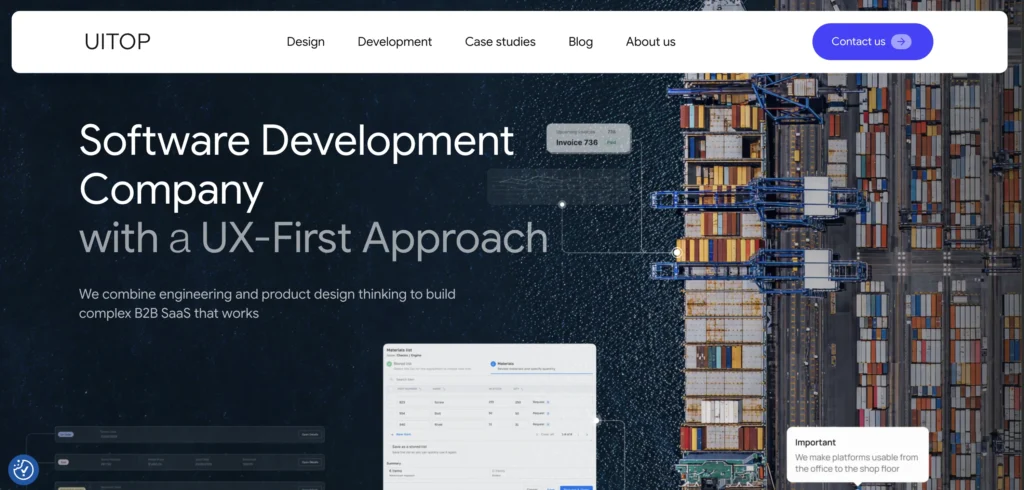
UITOP is a software development and product design agency for B2B SaaS, ERP, CRM, and business software. Ivan Klyzhenko started the company in Kyiv in May 2021 as a five-person design studio. Now, the team has moved from early-stage design into full-cycle engineering and legacy system modernization.
They build SaaS and AI platforms using AI tools, which lets the agency speed up the process by 33% and deliver clean architecture and UI/UX. Overall, the agency reports working with more than 100 software companies, and 74% of their clients stay for over two years.
What else makes the agency one of the top development companies for startups is that UITOP’s startup design services provide the foundation needed to scale. A typical MVP design runs six to eight weeks, while enterprise projects take three to six months.
The Slabstack ERP redesign helped secure a $3.4M seed round. WingWork, a private jet maintenance platform, landed its first clients and a $3.25M investment. Valocore, a government contracting tool, gained 137% more users in its first quarter.

Fireart Studio is a product design and software development company based in Warsaw, Poland, founded in 2013. Since then, the team has grown to around 100 full-time employees and delivered 700+ projects for 200+ clients worldwide, covering UI/UX design, web and mobile development, and graphic work. They position themselves as a full-cycle partner that takes the time to understand the business behind the product.
Fireart has worked with Google, Rolls-Royce, Atlassian, Pipedrive, Huawei, Swisscom, and Bolt, so the team is used to the high requirements that come with global brands. The company has ranked among the top design teams on Dribbble for years, and TOHU, a game from its Fireart Games arm, earned two nominations at the Webby Awards.

Halo Lab is a full-stack design and development team that has been building digital products for over a decade. The company works across the product lifecycle, from UI/UX and branding to web, software, and cloud development. Clients range from early-stage startups to brands like Corel and Oppo.
The team reports that their clients have raised over $500M in total, and the reviews repeatedly mention designs that helped stakeholders secure funding and lift conversion rates. Halo Lab also cites 70+ awards, including a Top-1 Dribbble Team ranking, Awwwards Honorable Mentions, and CSS Design Awards.

Shakuro is a digital design and development company founded in 2006, with a presence in Berlin and the US. After nearly two decades, it covers branding, UI/UX, web development, and mobile development for iOS and Android, working with both startup first-timers and established brands.
The team emphasizes staying with clients across years, maintaining and growing products. Shakuro reports Awwwards Honorable Mentions and recognition on Behance. The case studies cover real outcomes, including an education app that grew to 90,000 users and an iOS app whose App Store rating climbed from 3.8 to 4.8 after a Shakuro redesign.
Shakuro also uses AI tools to speed up research, layout, and developer handoff. If you want an experienced in-house team that can scale from a quick UI task to a full product build, Shakuro is a steady choice.

Limeup is a UX design and software development company based in the UK, with over a decade of experience and a team of more than 70 designers and engineers. The company has worked with 100+ clients worldwide, covering UX/UI design, web and mobile development, custom software, and MVP development.
Limeup puts research and design strategy at the front of their process. The case studies span industries from blockchain investment apps to English-learning platforms and financial services.
Limeup works with companies of all sizes, from emerging startups to enterprises and Fortune 500 firms, and offers discovery sessions, product audits, and technology leadership alongside delivery.

Codica is a custom web and software development company. The team specializes in MVPs, progressive web apps, SaaS platforms, and online marketplaces, building with Ruby on Rails, React, Angular, and Vue.js.
The company has been named among the top e-commerce and web developers in Ukraine by Clutch for several years running, and the case studies show practical results, including an activity-booking marketplace that helps parents plan children's leisure.
During discovery sessions, the team aligns with clients on goals, priorities, and risks, then keeps founders involved through weekly or bi-weekly demos. The industry coverage extends to Real Estate, Financial Services, Automotive, and Energy, so the team has worked across several regulated and operations-heavy domains.

Netguru is one of the larger companies on this list, founded in 2008 in Poznań, Poland, with more than 600 professionals. The team has delivered 1,000+ projects for clients in over 50 countries, covering consulting, product design, and software development across web and mobile.
Netguru has worked with IKEA, Volkswagen, Keller Williams, and Babbel, alongside fast-growing fintech companies like Solaris, Zeller, and Spendesk. The company is also a certified B Corp and has been recognized by the Financial Times, Deloitte, Awwwards, and Inc. 5000.
Yet, with a minimum project size around $50,000 and an enterprise-level process, Netguru is better suited to funded startups than to founders testing a first idea on a tight budget.

Stormotion is a mobile and web development firm, founded in 2016, that connects software with physical hardware. The team works with Bluetooth LE, Wi-Fi, LoRaWAN, and telemetry to build apps for wearables, kiosks, touch panels, and smart IoT devices. They serve clients across Europe, North America, and Australia.
The portfolio includes Caspar Health, a German digital rehabilitation platform used by 350,000 patients, and DeftPower, a white-label EV charging app with access to a million charging points in Europe.
Stormotion was named to the Clutch 100 fastest-growing companies for 2026, a ranking based on audited financial data rather than self-reported figures. The reviews highlight strong ownership and clean delivery. The team also covers AI and ML integration, team augmentation, and legacy modernization.

Brainhub is a software engineering company founded in 2015 in Gliwice, Poland. Since launch, the team has helped 80+ fast-growing companies across more than 20 industries build web, mobile, and desktop apps. They work with JavaScript, React, Node.js, .NET, and AWS.
Brainhub reinvented a subscription management system for National Geographic, serving over 6 million users, and connected it to a custom ERP. The company includes business analysts from the project start to keep technical decisions aligned with business goals.
Reviewers consistently mention transparency about timelines and challenges, and several cite prototypes delivered ready for investor demonstrations. Additionally, Brainhub has been recognized by the Financial Times 1000 and Deloitte's fast-growing company rankings.
Users now tend to compare every product with the best digital experience they had this week, not only with other tools in the same category. A finance manager using your reporting dashboard does not care that your startup is early-stage. Or a sales team trying your CRM add-on does not care that the backend is complex. They care whether the product helps them complete the job faster, with less confusion and fewer mistakes.
This is why more startups are choosing development teams that do not begin with code. They frequently opt for those who begin with users, scenarios, and business constraints.
UX-first teams typically ask:
Only after that does the team that follows the UX-first development approach decide what should be designed, built, automated, or removed.
This matters directly for product-market fit. Product-market fit is about whether people understand the product, trust it, return to it, and are willing to keep paying for it. Bad UX can hide a good idea. Users may leave not because the product is useless, but because they cannot reach the value quickly enough.
A weak onboarding flow can make founders think their positioning is wrong. Or a confusing dashboard can make them think customers do not need analytics. UX-first development reduces this risk. It helps the team test assumptions before the product becomes too expensive to change.
At the beginning, some offers may look similar. So startups often fall back on the easiest comparison point: price.
This is the first mistake.
A cheaper vendor may be the right choice for a small, clearly defined task. But building a SaaS product is rarely just a set of isolated tasks. It includes product logic, user flows, architecture, integrations, security, performance, analytics, and future scaling decisions. If the vendor cuts corners in areas the founder cannot see yet, the product may look fine in the demo and still become expensive to maintain.
The second mistake is ignoring the process. Startups sometimes ask, “How many developers can you provide?” when they should also ask:
A vendor without a clear process can still move fast. The problem is that fast movement without structure often creates hidden debt.
The third mistake is treating architecture as a later problem. Early-stage startups often think architecture matters only when the product scales. But architecture decisions begin from the first sprint. User roles, permissions, billing logic, data models, integrations, and deployment setup define what the product can become later. If a team builds only for the next demo, the startup may win a short-term milestone and lose long-term flexibility.
Another mistake is choosing a vendor that only waits for instructions. You write a task, they build it; you send feedback, they adjust it. But if no one on the vendor side thinks about the product as a whole, the founder becomes the only person connecting user needs, business goals, design choices, and technical tradeoffs.
The right vendor doesn’t remove responsibility from the founder. But it does share the thinking.
There are two very different ways to build a SaaS product.
The first is feature delivery. The client gives specifications, and the team estimates them, builds them, sends them for review, and moves to the next task. This model can work when the product is mature, the requirements are stable, and the team already knows exactly what needs to be done.

Startups rarely live in this world.
For startups, requirements change because the market talks back. For example, a pricing idea may require changes to permissions, usage limits, onboarding, and reporting.
Feature delivery does not handle this uncertainty well. It assumes the task is correct and focuses on completion. Product thinking asks whether the task should exist in the first place.
A product-minded team that covers the end-to-end product development process asks, “What problem are we solving, and is this the best way to solve it?” This question changes the quality of the final product. It can lead to a simpler interface, a smaller scope, a better data model, or a different release plan. Sometimes it leads to not building a feature at all, because the same outcome can be achieved with a small UX change or a smarter workflow.
Product thinking also affects speed. The speed of a SaaS startup is measured by how quickly the product learns, improves, and reaches users with something valuable.
A product-minded development company helps startups protect momentum. It connects design, engineering, and business context so that each release moves the product somewhere useful. It also helps founders avoid emotional roadmap decisions, where one customer or one investor comment suddenly reshapes the next two months of work.
In SaaS, growth usually comes from practical improvements: smoother onboarding, clearer value moments, better activation, fewer support tickets, faster workflows, stronger retention loops. A team that only delivers features may miss them. A team that thinks like a product partner will look for them.
The right SaaS development company depends on where the startup is now.
At the pre-seed stage, the biggest risk is usually building too much. The product is still a set of assumptions. Here, the best partner is the one that helps narrow the scope through discovery, prototyping, UX validation, and a realistic MVP plan.
At the seed stage, the product usually needs to become real enough for repeated use. The startup needs to improve onboarding, stabilize core workflows, add key integrations, and make the product easier to sell. At this stage, the vendor should bring both product and engineering disciplines. Speed still matters, but the team needs to ship, measure, learn, and adjust. It should help founders understand which parts of the product deserve investment and which parts are still experimental.
Series A is different. By then, the startup usually has stronger signals: customers, revenue expectations, a sales pipeline, and pressure to scale. The product has to support more users, more use cases, and more internal complexity.
A SaaS development company at this stage must understand architecture, security, performance, and team collaboration. It may need to work with an internal product team, support enterprise requirements, improve reliability, and reduce technical debt without stopping delivery.
For mature SaaS companies, the needs shift again. The product is about improving conversion, retention, scalability, operational efficiency, and expansion into new segments. The company may need specialized UX work, modernization, redesign of complex workflows, or support for new modules.
Design and development can be separated. Many startups work this way. A designer creates screens, a development team builds them, and the founder tries to keep both sides aligned.
Sometimes it works. But often, it creates friction that no one planned for.
The main issue is context loss. Product decisions are not contained only in Figma files or technical tickets but also in conversations: why a workflow was simplified, why a button was moved, why one user role needs a different experience, why a certain edge case matters for sales.
When design and development are separate teams, designers may not know which technical constraints matter, and developers may not know which UX details are essential and which ones are flexible. This slows the product development down.
A unified SaaS product design and development company changes the rhythm. UX, architecture, and development can discuss tradeoffs early, before they become reworked. If a design pattern is expensive to build, developers can explain why.
For SaaS products, this connection matters even more because the interface and the system logic are deeply tied. Permissions, dashboards, automation rules, billing, notifications, reports, and integrations all affect the user experience.
When design and development are under one roof, the team can make these decisions with the whole product in mind.
UITOP is included in this list of the best SaaS development companies because their approach fits what SaaS startups actually need: structured product thinking before and during development.
The company works with SaaS and complex digital products, where it’s necessary to understand how the product should work so that users understand it, adopt it, and keep using it. UITOP starts from discovery, user flows, product logic, and business goals. This helps the team design and build with fewer assumptions.
Another reason UITOP belongs here is the connection between design and development. SaaS products often become complicated fast: different roles, dashboards, permissions, onboarding paths, integrations, and data-heavy workflows. When UX and development decisions are made together, the product is less likely to suffer from the usual disconnect between attractive screens and difficult implementation.

For startups that need to clarify the product, design complex workflows, and build a SaaS product with a stronger foundation, UITOP has a clear reason to be on the list. The value of their product design services for SaaS startups is in matching the type of problems startups face when they move from an idea to a product people are expected to use every day.
Learn how it works
Building a SaaS product requires alignment between product, design, and development
Contact usChoosing the right SaaS development company matters for startups because every decision connects to growth: how users enter the product, how fast they understand the value, how easy the product is to improve, and how well it can support the next stage. A development team that understands UX, product logic, and SaaS architecture can help reduce guesswork and keep the product moving in the right direction.
The right partner should help clarify priorities, shape user flows, and build features that support real business goals. UITOP follows this approach through UX-first development, product discovery, SaaS design, and development under one roof. If you are building or improving a SaaS product, contact UITOP to discuss how we can help turn your product ideas into a clearer, more usable solution!
The best SaaS development company for a startup is the one that fits your current stage, understands your product risks, and can help you move from idea to a usable product without overbuilding. For early-stage startups, this often means a team with strong UX, product discovery, and SaaS development experience.
Start with the way the company thinks. A good SaaS development partner should ask about users, business goals, product stage, technical constraints, and future plans before estimating the work. Also look at their process: how they handle discovery, design, development, feedback, and changes. If the team only waits for fixed requirements, it may be harder to build a product that still needs to evolve.
Startups should not treat UX and development as two separate priorities. UX helps define what should be built, while development turns it into a working product. If you start coding too early, you may spend time building flows that users do not understand or need. A UX-first approach does not mean delaying development. It means making better product decisions before the expensive part begins.
SaaS development cost depends on the product scope, number of user roles, integrations, design complexity, security needs, and whether you are building an MVP or a more mature platform. A simple MVP will cost much less than a SaaS product with analytics, billing, automation, dashboards, and complex permissions. It’s better to define the first realistic product version and estimate from there.
A typical software vendor may focus mainly on delivering assigned tasks. A SaaS development company usually needs to think wider: product logic, user flows, subscription models, scalability, onboarding, retention, integrations, and long-term improvements. SaaS products are never really “finished” after launch. They keep changing with user feedback and business goals, so the team should be able to support both development and product decisions over time.